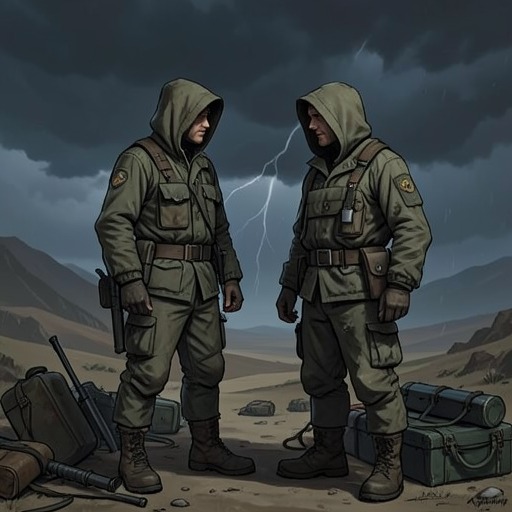
John Ford
The SwarmJohn Ford is the director of Vancouver Aquarium’s marine-mammal research programme and, as the whale attacks spread along the Pacific coast, one of the scientists charged with making sense of them. He organizes investigations, brings Leon Anawak into the emergency response, and helps assemble evidence that the whales’ behaviour is connected to a strange luminous organism. Yet Ford’s growing scientific picture is matched by a shrinking ability to share information: the committee receiving his reports gives little back, leaving him to investigate a crisis whose larger shape remains hidden from him.
Identity and Scientific Approach
Ford works at the intersection of marine-mammal research and public communication. When the orca Genghis is found dead on Vancouver Island, he proposes that its autopsy take place on the beach rather than behind closed doors. He wants students and journalists to see the animal in the setting where it was found, believing that an open-air examination might make the evidence feel less remote and encourage greater public involvement. He acknowledges the presentation has a performative element, but sees that as a means of making the science accessible, not a substitute for it.
The examination brings Ford together with Anawak, Sue Oliviera, Ray Fenwick, and Rod Palm. Fenwick conducts the autopsy and says that the external evidence points to a bacterial infection, while cautioning against a premature conclusion. Ford’s decision to convene the group and put the carcass before an audience establishes a recurring feature of his work: he seeks ways to turn observations into shared evidence, even when that evidence remains incomplete.
Building the Whale Investigation
As attacks recur along the western coast of North America, the Canadian authorities make Vancouver Aquarium the hub of science-based operations, with Ford leading the work. He is given responsibility for a mission without a ready-made explanation or an established protocol. He proposes Anawak as an adviser because of his expertise in whale behaviour, directing attention toward what the animals might be responding to rather than treating their actions as isolated incidents.
Ford and Anawak begin with the information available to them: the year’s Pacific-coast telemetry, positioning records, and hydrophone recordings. The gaps matter. Almost none of the whales migrating north from Hawaii and Baja California carried tags; two tagged humpbacks lost their transmitters shortly after their journey began. Video from the Blue Shark provides another line of evidence. By replaying and enlarging the footage with skippers who can recognize individual flukes, the investigators identify some of the attackers as humpbacks, a grey whale, and several orcas. The work narrows the field, but it does not yet explain why whales of different kinds are attacking vessels.
Ford is alert to the possibility that the attacks are changing. While overseeing the tagging operation from the Whistler, he watches Anawak’s DHC-2 Beaver approach and keeps radio contact with him on a secure frequency. The Whistler is a sixty-three-metre rescue tug with a bollard pull of 160 tonnes, formidable enough that Ford initially expects it to be beyond a whale’s reach. That apparent safety does not settle his concern: the whales have attacked vessels of different sizes, but their behaviour now seems more selective. Ford sees a growing ability to distinguish among targets, which makes a simple explanation based on indiscriminate illness less convincing and leaves him unsure how they will respond to the underwater robot.
Tracking and Interpreting the Animals
Ford’s investigation depends on linking individual whales to their movements and signals. In the observation laboratory, he monitors the URA’s footage alongside a three-dimensional display of whale positions. Soon after the robot enters the water, it matches Lucy’s tail-fluke pattern to the sounds she makes, allowing it to identify and locate her even if she dives beyond ordinary visibility. A tag embedded in Lucy’s blubber supplies heart rate, dive depth, position, temperature, pressure, and light readings. Together, the robot and tag give Ford’s team an unusually detailed record of a whale’s activity over twenty-four hours.
That record still requires interpretation. By 2 May, Ford and Anawak have spent forty-eight hours examining footage that begins in darkness, registers three audio signals outside the human range, and then reveals a blue-tinged luminous cloud. The cloud spreads around the whales; brief, tapered flashes strike Lucy and then move toward the others. When technicians slow and enhance the recording, they can study the sequence but cannot resolve what the organism is or how it operates. Ford and Anawak consult a Nanaimo biologist specializing in bioluminescence. The specialist agrees that the cloud and flashes are organic and proposes that the flashes may result from a chain reaction, while acknowledging that neither its trigger nor its function is known. The investigators’ conclusion is narrower but consequential: the cloud is responsible for the whales’ behavioural change.
Collaboration, Restraint, and Information Control
Ford’s dealings with Anawak show him balancing urgency with caution. He allows Anawak time to work through the remaining data rather than pushing him to announce a conclusion before the evidence is ready. At the same time, Ford is under pressure from politicians and their constant calls; when he joins the researchers, he emphasizes the need to understand the cause quickly. His approach is neither certainty nor passivity: he presses for progress while insisting that the data be sifted before conclusions are drawn.
The investigation’s institutional setting increasingly limits that work. Ford and his colleagues submit their findings to the emergency committee, but their report on the luminous organism disappears into what they privately call the Black Hole. After the U.S.-led allied committee is established, Vancouver Aquarium, the Nanaimo laboratory, and the University of British Columbia become links in a one-way information chain. Researchers are required to send findings, hypotheses, and frustrations, but receive no access to other groups’ work and no indication of how their contributions are being used. Ford complains that conditions changed after Judith Li took control. When Anawak asks Li for information, Ford’s own unsuccessful attempts to get answers have already shown how little authority the scientific team has over the knowledge it generates.
Narrative Role and Significance
Ford connects field research, technical observation, and emergency administration. His team can identify individual whales, reconstruct their movements, and establish that an organic luminous cloud is involved in the attacks; it cannot yet explain the cloud’s purpose or obtain the wider evidence needed to compare its results with other investigations. The contrast between the detailed data on Lucy and the committee’s opaque handling of the report captures the limits of scientific work during the crisis: greater precision about what happened does not automatically produce control over what is known.
Ford therefore serves as a disciplined but constrained investigator rather than a character who solves the mystery alone. He recognizes patterns in the whales’ target selection, helps test explanations against recorded evidence, and remains willing to mark uncertainty where the evidence stops. His collaboration with Anawak gives the inquiry a practical centre, while the emergency committee’s information blockade makes their discoveries harder to place in a complete account. The organism becomes more than a hypothesis, but Ford’s report does not end the uncertainty surrounding the attacks; it demonstrates both how much the scientists have learned and how much remains beyond their reach.